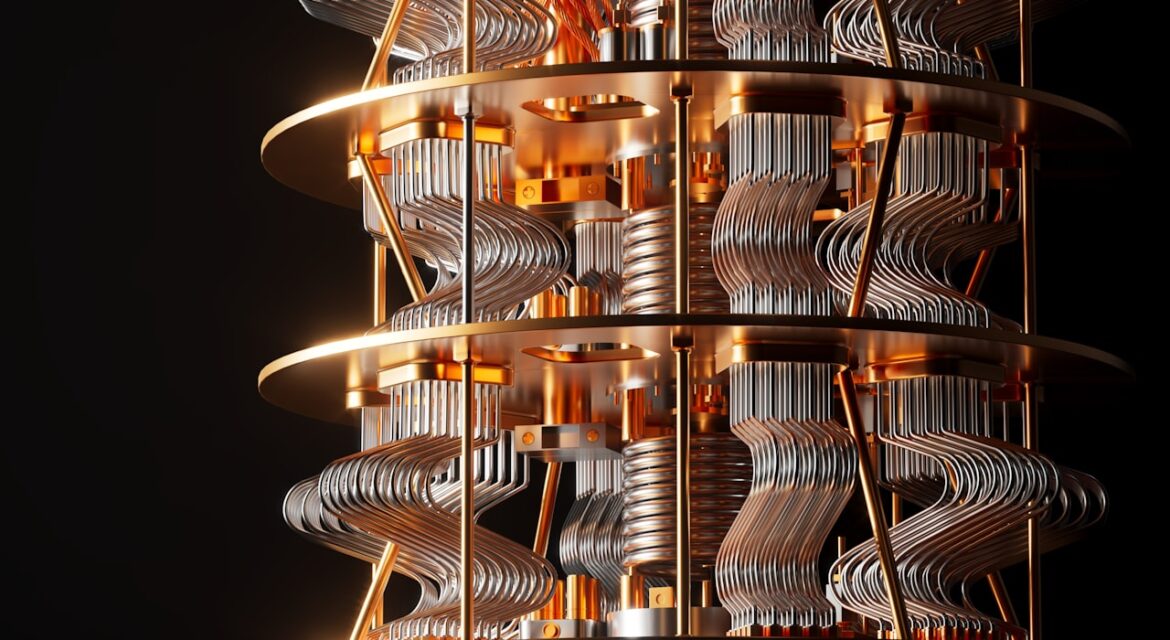
Yes, quantum computing will change the world. No, it won’t change yours — not your phone, not your apps, not the internet you scroll. The truth is stranger and more specific than the hype, and it starts with a physicist losing his temper.
“Nature isn’t classical, dammit”
In 1981, at a conference at MIT, Richard Feynman stood up and got annoyed.
The Nobel laureate was wrestling with a problem that had nothing to do with the gadgets we now associate with the word “quantum.” He wanted to know whether an ordinary computer — the kind that was, even then, getting faster every year — could ever truly simulate nature. Not approximate it. Simulate it, exactly, the way nature actually behaves.
His conclusion, delivered with a flash of impatience that physicists still quote four decades later, was blunt: “Nature isn’t classical, dammit, and if you want to make a simulation of nature, you’d better make it quantum mechanical.”
That sentence is the whole story in miniature. Feynman had spotted something the marketing departments of 2026 would rather you forget: the universe, at its smallest scales, doesn’t run on the tidy yes/no logic of ordinary computers. Atoms, electrons, and molecules live in a haze of probabilities, doing many things at once. To simulate them on a normal computer, you have to track every possibility — and the number of possibilities doubles with each electron you add. Add a few dozen electrons and you’d need more memory than there are atoms in the known universe.
The fix Feynman proposed was almost cheeky: if nature is quantum, build your computer out of quantum stuff too. Let it speak the universe’s native language. Then simulating a molecule wouldn’t require tracking a billion-billion possibilities — the machine would simply behave the way the molecule does.
That idea, born from a great physicist’s irritation, is the seed of everything. And it tells you exactly where quantum computing will change the world — and, just as importantly, where it won’t.
The machine that does one thing godlike, and most things badly
Here is the single most useful thing to understand about quantum computing, the thing that cuts through years of breathless headlines:
A quantum computer is not a faster computer. It’s a different kind of instrument entirely — one that is extraordinary at a few specific problems and useless at almost everything else.
The cleanest way to hold this in your head is an analogy: quantum computing is more like the MRI machine than the smartphone.
The MRI changed medicine forever. It let doctors see inside the living body without cutting it open — a genuine, civilization-grade breakthrough. But the MRI didn’t go in your pocket. It didn’t replace your camera or your calculator. Most days of most lives never touch one. It’s a powerful, expensive, room-sized specialist, wheeled in for the exact problems it was built for, and irrelevant to everything else.
Quantum computers are shaping up the same way. They will be transformative for a handful of problems that happen to be quantum-shaped — and beside the point for the ordinary computing that fills your day. To see why, you have to look at where the magic actually lives, and where it evaporates.
Where it will change the world
1. Chemistry and materials — the real “killer app”
Remember Feynman’s insight: the one thing a quantum computer is naturally built for is simulating the quantum behavior of molecules. This isn’t a marketing claim; it’s the technology’s home turf. And the prizes here are enormous.
Consider a single molecule called FeMoco — the iron-molybdenum cluster at the heart of an enzyme that bacteria use to pull nitrogen out of the air and turn it into fertilizer. Bacteria do this at room temperature, effortlessly. Humans do the same job through the industrial Haber-Bosch process, which runs at brutal temperatures and pressures and consumes an estimated 1–2% of all the energy used on Earth. If we understood exactly how that little cluster of atoms pulls off its trick, we might reinvent fertilizer production and shave a meaningful slice off global energy use.
The catch: FeMoco’s electronic structure is so tangled that classical computers can’t reliably model it. In a landmark 2017 paper, Microsoft’s Matthias Troyer, Markus Reiher and colleagues calculated what it would take — and concluded a quantum computer could crack it, but only one with thousands of high-quality “logical” qubits, which in turn require millions of physical ones. Far beyond anything that exists today.
This is the pattern everywhere you look in chemistry:
- When IBM and Daimler (Mercedes-Benz’s parent) used a real quantum computer to simulate the molecules inside next-generation lithium-sulfur batteries — the kind that could make electric cars cheaper and longer-range — they could only manage tiny pieces, calculating one molecule’s behavior using four qubits on a five-qubit machine. A proof of concept, not a product.
- When Google Quantum AI teamed up with the drugmaker Boehringer Ingelheim to study cytochrome P450 — the family of enzymes that metabolizes roughly 70% of all drugs that enter your body — the study’s honest conclusion was that simulating the process properly would need a few million qubits.
Notice the shape of all three. The science is real, the companies are real, the molecules matter enormously — and the verdict is always “once the machines are big enough.” That’s the chemistry promise: real, world-changing, and still years away. The payoff is better catalysts, better batteries, better carbon capture, better materials. The timeline is the 2030s, not now.
2. Drug discovery and medicine
The same engine — accurately simulating how molecules behave and bind — points straight at pharmaceuticals. Bringing a single drug to market famously takes well over a decade and billions of dollars, much of it burned on candidates that fail late. If quantum simulation could predict, early and accurately, how a drug molecule will actually interact with its target, it could cut enormous waste from that pipeline.

The big players are positioning for it. Boehringer Ingelheim became the first pharma company to partner with Google on quantum, even building its own in-house “Quantum Lab.” Others — Roche, Merck, Amgen, Cleveland Clinic — have made their own quantum moves. The consultancy McKinsey estimates quantum could eventually unlock somewhere between $50 billion and $400 billion in pharma value through faster R&D and cheaper clinical trials.
But here is where this story demands its most important asterisk — one the hype almost always skips.
While everyone was waiting for quantum to revolutionize biology, ordinary AI did it first. In 2024, the Nobel Prize in Chemistry went to Google DeepMind’s AlphaFold — a classical AI system, running on normal computers — for solving the 50-year-old “protein folding problem.” AlphaFold has now predicted the structures of essentially all 200 million proteins known to science and been used by more than two million researchers. It did not need a quantum computer. It needed a clever neural network.
That’s the moving target quantum has to hit: by the time quantum machines mature, the fields they were supposed to revolutionize will already have been reshaped by AI. Quantum’s value won’t be measured against the world of today. It’ll be measured against a world AI has already transformed — and that’s a far higher bar.
3. Digital security — the one change that touches everything, and it’s happening now
Here, finally, is the part of the quantum story that affects everyone — and the twist is that it has nothing to do with quantum computers helping you. It’s about them threatening you.

The encryption that protects nearly all digital life — your bank login, your messages, government secrets, the little padlock in your browser — relies on math problems that ordinary computers can’t crack in any reasonable time. A large enough quantum computer, running an algorithm devised by Peter Shor back in 1994, could shred a lot of it.
No such machine exists yet; the largest number a quantum computer has honestly factored is 15. But waiting for the threat to arrive would be a catastrophic mistake, because of a strategy with a name out of a spy thriller: “harvest now, decrypt later.” An adversary copies your encrypted data today and simply stores it, waiting for the day a quantum computer can open it. Any secret that needs to stay secret into the 2030s is, in a real sense, already at risk.
So the world is quietly re-encrypting itself — right now, while you read this. In August 2024, the U.S. standards body NIST published the first official “post-quantum” encryption algorithms, built to resist quantum attack. It set hard deadlines: the old encryption must be phased out by 2030 and banned entirely by 2035. And the migration is moving faster than almost anyone expected. By the end of 2025, Cloudflare — which carries a huge share of global web traffic — reported that post-quantum encryption had jumped from 29% to 52% of all human web traffic in a single year, crossing the halfway mark. Apple switched it on by default in iMessage and across iOS; Signal did it even earlier; Chrome, Edge and Firefox now negotiate it automatically.
This is the rare quantum change that reaches every piece of software that touches encryption — which is to say, nearly all of it. And for the engineers building that software, it has a name and a shape: crypto-agility, the discipline of routing encryption through one swappable layer so the algorithms can be replaced as threats evolve. It’s invisible plumbing. It’s also the single most consequential thing quantum computing is doing to software today — and it’s a defensive scramble, not a magic upgrade.
Where it will change nothing — probably forever
Now the part the trillion-dollar forecasts tend to whisper.
For the overwhelming majority of software, quantum computing will do nothing — not in 2029, not in 2040, not ever. The app you opened this morning, the website rendering these words, the spreadsheet running a small business, the database behind your bank, the recommendation engine picking your next video — none of these have a quantum-shaped problem, and none of them ever will.
This isn’t pessimism; it’s arithmetic, and the most credible person making the argument works at a quantum company. In a widely cited 2023 paper bluntly titled “Disentangling Hype from Practicality,” Microsoft’s Matthias Troyer and colleagues showed why. Many of the speedups people get excited about are “quadratic” — the famous Grover’s search algorithm, for instance. But quantum computers carry enormous overhead: each fragile operation has to be wrapped in layers of error correction, making every quantum step vastly slower than a classical one. Run the math, and the quadratic speedup gets entirely eaten by that overhead until the problem is astronomically large. Their conclusion: quadratic speedups are “insufficient for practical quantum advantage.”
Worse for the hype, there’s a data bottleneck. Quantum computers are terrible at swallowing large amounts of ordinary data — and most of modern computing, from machine learning to database search, is exactly that: big piles of classical data. Troyer’s team named the casualties directly. Big data, machine learning, database search — “almost certainly out of reach.”
That last point deserves emphasis, because it’s the opposite of what you’d guess from the headlines: there is no proven way for quantum computers to meaningfully speed up the AI everyone actually uses. The dream of “quantum machine learning” keeps running into a wall — researchers have repeatedly taken a flashy quantum-ML result and shown that an ordinary computer can match it, a debunking exercise so common it earned its own verb: dequantization.
There’s even a poetic reversal hiding in here. The most useful role for AI in the quantum world right now isn’t quantum helping AI — it’s AI helping build quantum. Google’s DeepMind built an AI system that reads a quantum chip’s errors more accurately than any hand-built method. Microsoft credits an AI research assistant with speeding up its latest chip’s design. The genuinely working collaboration between the two technologies runs the opposite direction from the one the marketing implies.
So: will it change the world?
Yes. But not the way the hype implies, and it’s worth being precise about both halves.
The world it will change: chemistry, materials, batteries, drug discovery, and digital security. Better fertilizers and a dent in global energy use; better batteries and cleaner energy; faster, smarter medicine; and an entire planet quietly upgrading its encryption. These are not small things. They are, in the most literal sense, civilization-level. That’s a genuine transformation — just a narrow one, concentrated in the few corners of reality that are quantum-shaped.
The world it won’t change: your phone, your apps, the internet you browse, most business software, and — despite every breathless pairing of the two buzzwords — most AI. For the vast ocean of everyday computing, classical machines stay better. Probably forever.
And keep the timing honest. The dates on the vendor slides — Microsoft and IBM both pointing at 2029, Quantinuum and IonQ at 2030 — are targets, not facts, and the big chemistry-and-medicine payoffs are a 2030s story at the earliest. Even then, they’ll be measured against an AI baseline that, as AlphaFold already proved, is remaking the very same industries faster and more cheaply right now.
Feynman, characteristically, had it right in 1981, before any of the hype existed. He didn’t promise a machine that would do everything. He pointed at one specific, wonderful, hard problem — simulating nature — and said that’s what this strange new kind of computer is for. Forty-five years later, that’s still the truest sentence anyone has said about quantum computing.
It’s an MRI for the molecular world. Built for a few profound jobs, and gloriously, deliberately, not for everything else.
Sources
Feynman’s origin and the simulation insight
- R. P. Feynman, “Simulating Physics with Computers,” International Journal of Theoretical Physics, vol. 21 (1982), p. 467–488 (quote at p. 486)
- Quote citation (libquotes)
- Nature Physics, “Quantum simulation” (Feynman framing)
Chemistry & materials (FeMoco, batteries)
- Reiher, Wiebe, Svore, Wecker & Troyer, “Elucidating reaction mechanisms on quantum computers,” PNAS (2017)
- C&EN, “Chemistry is quantum computing’s killer app”
- ETH Zurich, “Clarifying complex chemical processes with quantum computers”
- IBM Quantum, “IBM and Daimler use quantum computer to develop next-gen batteries”
- Rice et al., “Quantum Chemistry Simulations of Dominant Products in Lithium-Sulfur Batteries” (arXiv)
Drug discovery & life sciences
- Boehringer Ingelheim, partnership with Google Quantum AI
- Goings et al., “Reliably assessing the electronic structure of cytochrome P450…,” PNAS (2022)
- IEEE Spectrum, “Here Are 6 Actual Uses for Near-Term Quantum Computers”
- McKinsey, life-sciences/pharma value estimates
The classical-AI baseline (AlphaFold)
- NobelPrize.org, Chemistry 2024 press release (AlphaFold, 200M proteins, 2M+ users)
- Nature, “Chemistry Nobel goes to developers of AlphaFold”
Digital security / post-quantum cryptography
- NIST, first finalized post-quantum encryption standards (Aug 2024)
- Cloudflare, “The 2025 Radar Year in Review” (29% → 52% of human web traffic)
- Cloudflare, “State of the post-quantum Internet in 2025” (harvest-now-decrypt-later; largest factored number is 15)
- Cloudflare, WARP PQC post (NIST 2030 deprecate / 2035 disallow)
What won’t change (the limits)
- Hoefler, Häner & Troyer, “Disentangling Hype from Practicality: On Realistically Achieving Quantum Advantage,” Communications of the ACM 66(5) (2023) — preprint
- HPCwire summary, “Microsoft and ETH Take Aim at Quantum Computing’s Hype (and Promise)”
Vendor timelines & market forecasts (targets, not facts)
- IBM Quantum, roadmap to fault tolerance (Starling, 2029)
- McKinsey Quantum Technology Monitor 2026
- BCG, quantum value up to $850B by 2040
- Gidney (2025), factoring RSA-2048 with <1M noisy qubits