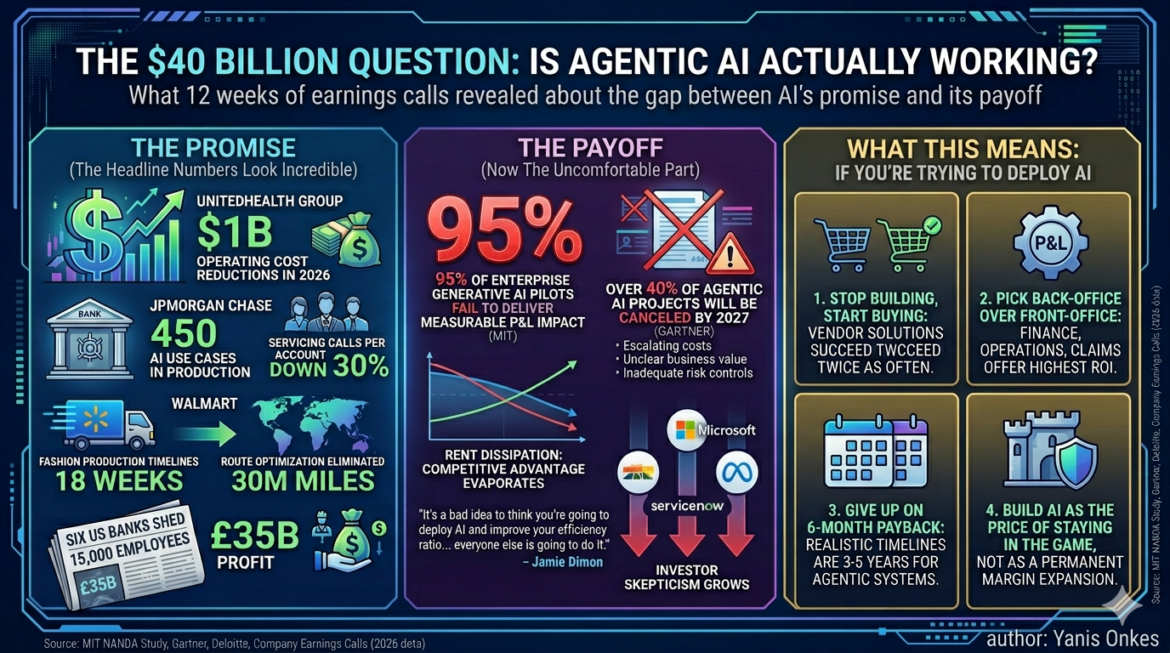
On a chilly January morning in 2026, Jamie Dimon — chairman of the largest bank in America — said something on an earnings call that nobody in Silicon Valley wanted to hear.
“It’s a bad idea to think you’re going to deploy AI and improve your efficiency ratio. Because in a competitive world, I’m going to do it, everyone else is going to do it.”
— Jamie Dimon, JPMorgan Chase Chairman, January 2026 Earnings Call
Translation: even if AI saves JPMorgan billions, those savings get competed away across the industry. The winner isn’t the bank with AI. It’s the bank with AI plus something else.
This is the uncomfortable subtext of the agentic AI gold rush — and after spending weeks digging through Q1 2026 earnings calls, MIT studies, and Gartner forecasts, I’m convinced most enterprises are getting the story exactly wrong.
The headline numbers look incredible
Let me start with the seductive part. Because the numbers from companies that figured out agentic AI are genuinely staggering.
- UnitedHealth Group is targeting $1 billion in operating cost reductions in 2026, with the company explicitly saying “many of them AI-enabled.” Over 80% of member calls now route through AI tools. They’re spending $1.5 billion on AI this year. Same in 2027.
- JPMorgan Chase has 450 AI use cases in production, with plans to hit 1,000 by year-end. Their LLM Suite is deployed to 200,000+ employees. Servicing calls per account are down 30%. Processing costs are down 15%. The company is spending $19.8 billion annually on tech and AI.
- Walmart’s “Trend-to-Product” AI system cut fashion production timelines by 18 weeks. Route optimization eliminated 30 million unnecessary delivery miles. Their AI improved 850 million product catalog data points — a task that would have required “100 times the headcount” manually.
- Bank of America reported a Q1 2026 quarterly profit of £6.5 billion — up £1.2 billion year-over-year — explicitly crediting “headcount reduction and automation.”
- McKinsey’s AI agent fleet grew 500% in 18 months to roughly 20,000 agents, claiming 1.5 million hours of human work saved.
Six of America’s largest banks — JPMorgan, Citi, Bank of America, Goldman Sachs, Morgan Stanley, and Wells Fargo — collectively shed 15,000 employees in Q1 2026 while posting £35 billion in combined profits, up 18% year-over-year.
This is the part of the story everyone wants to tell. It’s also incomplete.

Now the uncomfortable part
Here’s what doesn’t make the LinkedIn keynote slides.
MIT’s NANDA initiative published a study analyzing 300 public AI deployments, surveying 350 employees, and interviewing 150 business leaders. Their finding: 95% of enterprise generative AI pilots fail to deliver measurable P&L impact.
Not 50%. Not 70%. Ninety-five percent.
Gartner’s latest research goes further: over 40% of agentic AI projects will be canceled by the end of 2027 due to escalating costs, unclear business value, and inadequate risk controls. The firm estimates only about 130 of the thousands of vendors claiming “agentic AI” capabilities are legitimate. The rest are doing what Gartner analyst Anushree Verma calls “agent washing” — slapping the word “agent” on chatbots and RPA tools.
Deloitte’s State of AI in the Enterprise 2026 report adds nuance: Yes, 66% of organizations report productivity gains. But only 20% report actual revenue growth from AI. The other 74% are still “hoping.” Just 34% are using AI to deeply transform their business — the rest are tinkering at the edges.
So which is it? Is agentic AI delivering trillions in value, or is it the most expensive failed pilot program in corporate history?
Both. At the same time. To different companies.
The defining variable isn’t industry. It isn’t company size. It isn’t AI sophistication. After weeks of cross-referencing earnings calls with academic research, the pattern is dishearteningly simple:
| Approach | Success Rate |
|---|---|
| Buy vendor solutions, back-office focus, executive governance, 2–4 year ROI horizon | ~67% |
| Build internally, sales/marketing pilots, 6–12 month payback expectation, distributed experiments | ~33% |
That’s the entire game.
JPMorgan didn’t accidentally land 450 use cases in production. They built a 200,000-person rollout under a CIO with explicit accountability and a $19.8 billion budget. UnitedHealth isn’t targeting $1 billion in savings because the technology magically appeared. They wrote a five-year capex plan, hired the right leadership, and tied AI deployment to specific operational metrics. Walmart’s CEO didn’t just declare an “AI strategy” — he restructured the org chart to create four “super agents,” reporting directly to him.
Compare that to the typical enterprise pilot: a director somewhere gets curious about ChatGPT, runs a six-month proof-of-concept on a sales workflow, sees a 15% improvement in some demo metric, declares victory, and watches the project quietly die when nobody can articulate the production business case to the CFO.
That second story isn’t AI failing. It’s management failing — using AI as the vehicle.

The competitive dynamics nobody is pricing in
Here’s where Dimon’s January warning becomes prophecy.
Picture three banks in a regional market. Bank A deploys AI customer service, cuts call center costs 30%, and uses the savings to lower fees. Bank B follows six months later, matches the price cut, and the differentiator evaporates. Bank C does the same. Now all three banks have the same cost structure they had before — minus the customer service jobs, plus the AI vendor invoices.
This is happening right now, in real time, across every industry.
Bank of America’s profit increase was attributed to automation. So was Wells Fargo’s, which has now logged 22 consecutive quarters of headcount reduction. So was JPMorgan’s. So was Goldman’s. When every competitor extracts the same productivity gain, the structural advantage disappears — and what remains is permanently lower employment, permanently higher AI costs, and roughly the same competitive positioning.
The economists call this “rent dissipation.” Investors are starting to notice. Microsoft sold off 35% peak-to-trough between October 2025 and April 2026. ServiceNow dropped 13% on a beat-and-raise. Meta fell 7%. Palantir sold off after posting 85% year-over-year revenue growth.
The market is pricing the return on capex — and it’s increasingly skeptical, even as it acknowledges the topline numbers are real.
What this means if you’re trying to deploy AI in your company
Three things, based on what the winners are actually doing:
First, stop building. MIT’s data is unambiguous — vendor solutions succeed twice as often as internal builds. Unless you have proprietary data and unique competitive differentiation, buying beats building.
Second, pick back-office over front-office. MIT identified sales and marketing pilots as the worst-performing category. The highest ROI sits in finance, claims processing, document review, code generation, and operations — the unglamorous middle of the enterprise where work is codifiable and outputs are measurable.
Third, give up on 6-month payback. Realistic timelines, per multiple research sources: back-office automation 6–18 months, generative AI applications 1–2 years, agentic AI systems 3–5 years. If your business case demands faster, you’re going to declare failure before the technology has a chance to work.
And a fourth thing, which the data won’t tell you but Dimon will: assume the advantage will be competed away. Build AI capability anyway — because not building it is worse — but don’t model the savings as permanent margin expansion. Model them as the price of staying in the game.
The verdict
Agentic AI is unambiguously delivering ROI for the minority of enterprises that have figured out how to deploy it. The banks have cracked the code furthest. Healthcare, retail, and consulting are close behind. For these companies, the productivity gains are real, the cost savings are real, and the headcount reductions are real.
For the other 80% of enterprises, agentic AI is currently a very expensive line item on the IT budget that hasn’t yet moved the P&L.
Whether you end up in the first group or the second has almost nothing to do with the technology. It has everything to do with whether your leadership treats AI as a strategic transformation requiring patience and discipline — or as a press release waiting to be written.
The honeymoon is over. The math is starting.
Sources
- JPMorgan Q1 2026 earnings call transcript
- JPMorgan AI strategy analysis, Emerj
- Bank of America 270 AI models, CIO Dive
- BofA / Wells Fargo job cuts, Axios Charlotte
- Six US banks shed 15,000 jobs, ResultSense
- UnitedHealth $1B AI savings target
- Walmart AI strategy, AI News
- Deloitte State of AI in the Enterprise 2026
- MIT NANDA study (95% failure rate), Fortune
- Gartner 40% project cancellation forecast
- AI agent adoption analysis, Joget