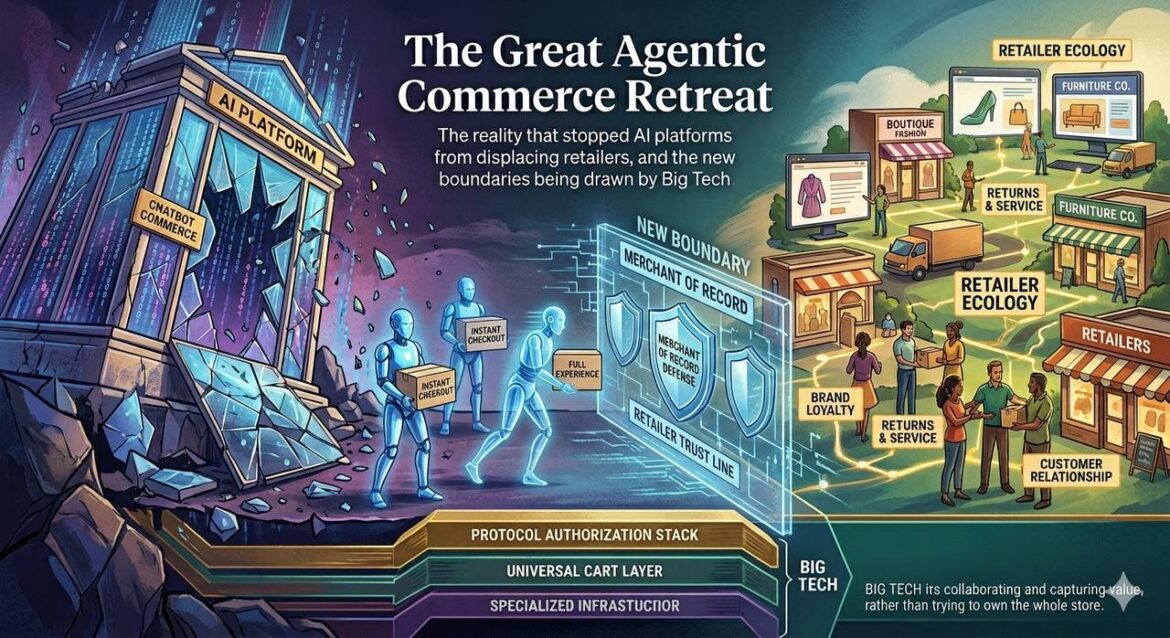
The reality that stopped AI platforms from displacing retailers, and the new boundaries being drawn by Big Tech.
Two products. Same label. Opposite outcomes.
In September 2025, OpenAI gave 800 million weekly users a way to buy things without ever leaving ChatGPT.
You’d describe what you wanted in plain English — running shoes, an espresso machine, a birthday gift — and ChatGPT would handle the rest. No tabs. No retailer site. The order would appear in your email. The product would appear at your door. The feature was called Instant Checkout. Stripe built the rails. The underlying standard, the Agentic Commerce Protocol, was open-source. Etsy was the launch partner. More than a million Shopify merchants were lined up to follow.
If any company on Earth could brute-force AI shopping into reality, it was this one.
Six months later, OpenAI quietly walked it back. Forrester’s March 2026 post-mortem — titled, with admirable bluntness, “What it means that the leader in ‘agentic commerce’ just pulled back” — reported that only a small fraction of eligible Shopify merchants had actually integrated. OpenAI repositioned Instant Checkout toward narrower discovery use cases. The maximalist version of the bet was over.
Two months later, at Google I/O in May 2026, Sundar Pichai introduced Universal Cart.
It is not the same product. Not even close.
Universal Cart is not a chatbot that buys things for you. It’s a shopping cart that follows you across Google’s surfaces — Search, Gemini, YouTube, Gmail. Add a pair of Nikes from one screen, a Sephora foundation from another, a Wayfair side table from a third. One cart, all without leaving Google. The cart watches prices in the background and alerts you when items drop. It knows your loyalty programs. When you’re ready to buy, you press the button — not the AI. Google Pay splits the order across the merchants. The retailers, critically, still own the customer relationship.
Same industry. Same label. Architecturally, near-opposites.
OpenAI tried to own the entire shopping experience inside its chatbot: discovery, transaction, payment, the moment of decision, and — through its reported take-rate on top of existing merchant fees — the economics. Google built something narrower. Universal Cart owns one layer — the cart that sits between agents and retailers — and leaves everything else to the people who already do it well. Retailers handle the merchant relationship. Card networks handle authorization. Open protocols handle the technical plumbing. The user, not the AI, handles the final purchase decision.
The product that tried to own the most struggled. The product that picked one layer and went deep is scaling.
This is not a coincidence. It is the single most important pattern in agentic commerce, and it shapes every projection that follows.

How big is this, really?
Read three analyst reports on agentic commerce and you’ll get three wildly different futures.
McKinsey projects $3 trillion to $5 trillion globally by 2030, with up to $1 trillion in US B2C retail. eMarketer puts US sales via third-party AI platforms at $144 billion by 2029. Morgan Stanley estimates $190 billion base, $385 billion bull for US agentic commerce by 2030. Bain says 15 to 25 percent of US e-commerce could be touched by AI agents by 2030. Gartner claims $15 trillion of B2B buying will flow through AI agents by 2028.
These cannot all be right at face value. They are measuring different things.
McKinsey counts everything an AI agent touches. eMarketer counts only what’s bought inside a chatbot. Bain counts purchases agents “initiated or influenced.” Morgan Stanley wants “meaningful autonomous action.” Gartner uses the loosest definition imaginable.
The whole industry has been using one term to mean five different things. That’s why the news cycle keeps oscillating between hysteria and silence.
Strip the methodologies bare, and a usable projection appears.
Agent-influenced commerce will be enormous. The share of US e-commerce where an AI agent meaningfully shapes the discovery, comparison, or decision phase is plausibly between 25 and 40 percent in digitally native categories by 2030. This is the “AI helped me shop” layer. It is already happening at scale.
Agent-executed commerce — where an AI completes a purchase autonomously — will be much smaller. A reasonable base case is 8 to 15 percent of US e-commerce by 2030.
Three structural reasons keep autonomous execution capped.
First: the trust ceiling. Checkout.com’s December 2025 survey of 4,000 US and UK consumers found the average American is comfortable letting an AI agent spend autonomously up to $223 per transaction. In the UK, £204.53. Bain’s November 2025 trust survey reached a similar directional finding: comfort drops sharply above the cost of a midweek grocery run. ChannelEngine’s 2026 report found only 17 percent of consumers globally trust AI enough to complete a purchase on their behalf. That $223 ceiling sits well below the average order value of the categories where most retail profit lives — electronics, furniture, midrange apparel, travel, anything emotional. Maximalist forecasts implicitly assume this ceiling rises dramatically by 2030. There is currently no evidence it will.
Second: the trust-transfer effect. Bain found consumers trust AI assistants embedded inside retailers they already use roughly three times more than AI assistants inside general-purpose chatbots. Trust doesn’t appear from a cold start. It moves from places it already lives. A chatbot earning shopping trust from zero is fighting the laws of consumer psychology.
Third: the merchant-of-record outcome. As of mid-2026, every major commerce protocol — Google’s UCP, OpenAI’s ACP, Microsoft’s Copilot Checkout — keeps the retailer as merchant of record. Microsoft’s launch page states it explicitly: “Copilot does not become merchant of record.” That outcome was not inevitable. The platforms tried to take more of the customer relationship than they ended up keeping, and discovered they couldn’t make the economics work — sales tax compliance across thousands of US jurisdictions, chargeback liability, returns logistics, customer service. All genuinely difficult work. The platforms blinked.
Three constraints. Same direction. Together they explain why aggressive autonomous-execution products keep stalling, and why narrower assistant-style products keep scaling.
The stack — and who wins each layer
Most coverage frames agentic commerce as a protocol war. It isn’t a war. It’s a layer cake. Different companies are quietly claiming different layers, and almost nobody serious is trying to win the whole thing anymore.
Four layers matter.
The substrate layer. Anthropic released the Model Context Protocol (MCP) in November 2024, almost without marketing. It’s the wire format — how an AI agent talks to a tool, queries a database, reads an inventory feed. Server downloads grew from under 100,000 in November 2024 to roughly 8 million by April 2025. By the end of 2025, OpenAI, Google, Microsoft, Amazon, and Apple had all adopted it. Apple began integrating MCP support in iOS 26.1 developer betas in September 2025. In December 2025, Anthropic donated MCP to the Linux Foundation under the new Agentic AI Foundation.
Projection: MCP becomes the TCP/IP of agentic AI by 2030. There is no serious competing alternative. Anthropic gains a quiet platform advantage by being the originator — even after losing direct control. This is Google’s Kubernetes playbook from a decade ago. It worked then. It’s working again.
The commerce protocol layer. OpenAI’s ACP, co-developed with Stripe and launched September 29, 2025. Google’s UCP, co-developed with Shopify and launched at NRF on January 11, 2026 with endorsement from more than 20 retailers and payment networks. They look like competitors. They will more likely coexist long-term — the way OAuth and SAML coexist in identity today.
Projection: Both protocols survive through 2030. Retailers integrating both will capture more agent-driven traffic than retailers betting on one.
The payment authorization layer. Google’s Agent Payments Protocol (AP2), launched September 16, 2025 with 60+ partners including PayPal, Mastercard, American Express, Coinbase, and Adyen. Visa’s Trusted Agent Protocol, launched October 14, 2025 with 12 partners including Stripe, Shopify, and Microsoft. Coinbase’s x402 for stablecoin micropayments.
Projection: AP2 becomes the dominant authorization standard for high-value agentic transactions, particularly after Google’s April 28, 2026 donation of AP2 to the FIDO Alliance — the same standards body that brought the world passkeys. Card networks retain their network-of-record role regardless of which protocol wins. This may be the most defensible position in the entire stack.
The distribution layer. Apple, Google, Microsoft, and Amazon are all competing for the role of the default agent on consumer devices. Recent antitrust rulings in US v. Google — particularly Judge Mehta’s remedies decision in September 2025 — have changed the economics of exclusive default deals. Court records show Apple had been receiving roughly $20 billion per year from Google for being Safari’s default search engine.
Projection: No single AI agent becomes the universal default by 2030. Apple is unusually well positioned here, quietly, because it can now sell multi-default placement on iOS to several AI providers at once. Same economic model that has already earned Apple billions. The difference now is there are multiple bidders.
Look at the pattern. Nobody serious is trying to own the whole stack anymore. Everyone is racing to own one layer of it. That only makes sense if everyone has quietly decided agentic commerce is not winner-take-all.
This is also why Apple’s silence matters more than people realize. Apple has not shipped a single consumer-facing AI shopping product. Most coverage reads this as Apple falling behind. The opposite is true. Apple is building the substrate — App Intents, MCP support, the gating layer for what agents can do inside iOS — and positioning to own the toll booth on every road AI agents drive on. Apple isn’t trying to be the agent. Apple is trying to be the road.

Where adoption actually happens
Agentic commerce won’t arrive evenly. It will arrive first in narrow places, then spread.
The categories likely to see autonomous agent execution by 2030 share a pattern: low transaction value, frequent repeat purchase, low emotional weight, low return risk. Groceries. Household replenishment. Personal care. CPG. Subscription reorders. Low-AOV apparel. Standardized B2B reorders. Morgan Stanley found that 49 percent of AI-assisted purchases in their consumer research were groceries — consistent with the trust-ceiling pattern.
The categories that stay mostly assistant-mode through 2030 share the opposite pattern: high AOV, infrequent purchase, emotional weight, brand affinity, return complexity. Electronics. Major appliances. Furniture above a few hundred dollars. Apparel above midrange. Travel above budget tier. Gifts. Healthcare. Prescriptions. Anything aspirational.
The $223 trust ceiling maps almost perfectly onto this split. The first list is what people will let an AI buy autonomously. The second list is what they won’t.
Generationally, the picture is clearer. Checkout.com found 72 percent of 25-to-34-year-olds comfortable letting an AI agent spend their money, compared to roughly one-third of consumers over 45. Demographic replacement alone — younger people aging into the workforce, older people aging out — closes 8 to 12 percentage points of the trust gap by 2030 before any product or design improvements.
Internationally, the picture is dramatically different. Alipay’s AI Pay processed more than 120 million transactions in a single week in early February 2026, surpassing 100 million users — the first AI-native payment product to do so. Alibaba’s Qwen consumer surfaces reached 300 million monthly active users by early 2026. The Western agentic commerce stack, combined, has not produced anything in the same order of magnitude.
The architecture is also different. China embedded the agent inside Alipay — a financial app consumers had already used and trusted for a decade. The trust came pre-installed.
The implication for Western projections is uncomfortable. China’s adoption curve isn’t a preview of America’s. It’s a different architecture. If Western agentic commerce had been built inside Apple Pay or Chase Mobile rather than inside ChatGPT, the trust curve might look very different. It wasn’t. So it doesn’t.
Three futures. Honest probabilities.
By 2030, US agentic commerce lands somewhere in one of three places.
Base case — about 55 percent probability. Agent-executed commerce reaches 10 to 15 percent of US e-commerce. Agent-influenced commerce reaches 30 to 40 percent. Retailer-owned agents win the trust battle. Multiple protocols coexist. AP2 becomes the FIDO-stewarded authorization standard. Apple captures meaningful platform value without launching its own consumer agent. The story of the decade is re-layering, not replacement.
Bull case — about 20 percent probability. Agent-executed commerce reaches 20 to 25 percent of US e-commerce. Trust comfort rises substantially. Protocol convergence accelerates. Several large platform AI agents achieve durable transactional roles, particularly in groceries and CPG. Leading indicators: AP2 reaches passkey-level ubiquity by 2027; one or more major retailers report agent-driven sales exceeding 15 percent of GMV by 2028; consumer trust surveys show autonomous-spending comfort thresholds above $500 by 2028.
Bear case — about 25 percent probability. Agent-executed commerce stays below 5 percent of US e-commerce. Regulatory action — particularly around the Computer Fraud and Abuse Act and platform authorization (visible in Judge Maxine Chesney’s March 2026 preliminary injunction in Amazon v. Perplexity) — constrains third-party agents from accessing retailer surfaces. A major liability event triggers an insurance crisis. Gartner’s October 2025 prediction of more than 2,000 “death by AI” legal claims and $5 billion in compliance spending by end of 2026 suggests this is not far-fetched. Consumer trust stalls. The “agentic AI winter” arrives. Leading indicators: Ninth Circuit affirmation of Amazon v. Perplexity; one or more nine-figure tort cases against agent providers; consumer trust surveys flat or declining through 2027.
The most likely composite outcome is messier than any one of these. A base-case backbone, with bull-case dynamics in retailer-embedded agents (Rufus, Sparky, owned assistants) and bear-case dynamics in third-party autonomous execution. The two halves of agentic commerce diverge. The embedded agents compound. The chatbot agents plateau outside of discovery.
In hindsight, the change will look less dramatic than the “AI eats retail” framing predicted — and more important. The change won’t be that ChatGPT replaces Amazon. The change will be that the layers of commerce get re-assigned to different companies, and the companies that picked their layer early will compound for the rest of the decade.

What it means for retailers
If you run a retail brand, the rest of this article is for you. The opportunity is large. The risks are concrete. The window to act is narrower than most retailers assume.
Start with the opportunity. Agent-driven discovery is already large and growing fast. Adobe Analytics reported AI-driven referral traffic to US retail sites up 4,700 percent year-over-year by July 2025, 805 percent on Black Friday 2025, and 693 percent over the full 2025 holiday season. Salesforce reported that 20 percent of all global online orders during Cyber Week 2025 involved AI tools or agents — roughly $67 billion. Shopify’s December 2025 8-K reported AI-driven traffic up 8x year-over-year in 2025 and AI-driven orders up 15x. Adobe data shows AI-referred traffic converts at meaningfully higher rates than non-AI traffic. The shoppers arriving through ChatGPT or Gemini referrals are higher-intent than the shoppers arriving through generic search.
Two specific risks deserve attention.
Merchant-of-record erosion. Platforms kept retailers as merchant of record through mid-2026. That outcome is not permanent. Amazon’s “Buy for Me” architecture, which expanded from 65,000 products at launch in April 2025 to more than 500,000 products by November 2025, is structured in ways that could move the merchant relationship toward the platform. Retailers who don’t negotiate merchant-of-record language into their platform contracts now will have less leverage when the next attempt comes. The next attempt is coming. Probably in 2028. Probably in categories where the platform’s brand exceeds the retailer’s — travel, groceries, generic CPG.
Catalog invisibility. As consumers shift discovery toward AI agents, retailers whose product data isn’t machine-readable become invisible at the moment of purchase. BrightEdge 2026 research found pages with structured data are cited 2.1x more often in Google AI Overviews. Google’s AI Shopping data suggests stores with 99.9 percent attribute completion see 3-4x higher AI visibility. The technical work is unglamorous: schema.org product data, llms.txt files, AGENTS.md declarations, real-time inventory APIs, agent-readable returns and shipping data. The consequences compound quickly. Brands invisible to AI agents in 2026 will be invisible to AI shoppers in 2028.
Concrete projections for retailer strategy through 2030:
Retailers that build their own AI assistants on their owned surfaces will retain meaningfully more customer relationship value than those who rely on third-party agents. Amazon’s Q4 2025 earnings call reported Rufus delivered approximately $12 billion in incremental annualized sales, with Q1 2026 monthly active users up 115 percent year-over-year and engagement up 400 percent. Rufus users were reported 60 percent more likely to complete a purchase. Walmart’s Sparky, launched June 6, 2025, reached 81 percent usage among Walmart Connect-surveyed shoppers within months. The trust premium for owned assistants is substantial and durable. Trust transfers from the brand. It doesn’t transfer from a chatbot.
The retail media business will be partially disrupted. US retail media spend was roughly $58.79 billion in 2025, projected to reach $69.33 billion in 2026. Search ads account for around 60 percent of retail media spend. If agentic discovery captures even 15 percent of product-research queries by 2028, the disruption is direct and material — on the order of $5 to $8 billion of annual revenue at risk. Retailers with large retail media businesses — Amazon, Walmart, Target, Kroger — should plan for this transition explicitly. Assuming continuity is a mistake.
Loyalty programs become more important, not less. Loyalty data is one of the few pieces of customer relationship that cannot easily be disintermediated by agents. Retailers with strong loyalty programs have a structural advantage in the agent era. Retailers without them should be building them now.
Mid-size brands face the hardest decision. Large retailers can fund first-party agents and protocol integrations. Small merchants are well-served by Shopify and similar platforms. Brands in the $50 million to $500 million revenue range need to decide now whether to build owned agent capability, rely on platform integrations, or use middleware providers like Firmly.ai (11 million merchants, $900 billion GMV through its multi-protocol platform) or Rye (15,000+ merchant network). Most have not yet made this decision deliberately. The cost of delay is not high in 2026. It will be high by 2028.
The 2026-to-2028 window is when retailer leverage exists. Platforms are currently open to favorable merchant terms because they need merchant supply to make their products work. That window will close as agent products gain consumer adoption and the negotiating power shifts. Retailers who lock in strong terms now will benefit through 2030. Retailers who wait will negotiate from weakness.
One takeaway: the platforms tried to take more of your customer relationship than they could hold onto. They retreated. You have a window. Use it.
What it means for product managers
If you’re a PM working anywhere near commerce, search, content, AI, or B2B SaaS, agentic commerce is rearranging your craft.
Treat the next five years as a curriculum.
Protocol literacy becomes table stakes. Understanding MCP at an implementation level, and ACP, UCP, AP2, and TAP at a strategic level, will be the equivalent of what API design literacy was in the 2010s. PMs who can’t speak this language will be at a real disadvantage in any commerce-adjacent role.
Structured data and machine-readability becomes part of product hygiene. Schema.org product data, llms.txt, AGENTS.md, real-time inventory APIs. PMs who can’t articulate their product’s agent-readability — what an AI agent sees, parses, and acts on — will struggle to defend their roadmap.
Trust and consent design emerges as a distinct discipline. As agents take on more autonomous behavior, designing for human approval moments, audit trails, verifiable consent, and undo flows becomes its own craft. This is closer to security and privacy design than to traditional UX. Most product teams don’t have this skill yet. The ones that build it early will be ahead.
Multi-agent stakeholder thinking expands the persona model. PMs need to design for the user’s AI agent as a stakeholder, not just the user. What does the agent see? What can it parse? How does it represent your product to the human? This is a meaningful expansion of who PMs are building for.
The metrics are changing too. A few that will become standard through 2030:
- Agent Referral Rate (ARR) — percentage of sessions originating from AI agents. Adobe benchmark range: 1-25 percent depending on category.
- Agent Conversion Delta — difference in conversion rate between agent-referred and human-direct traffic. Microsoft first-party data published January 2026 claims a 194 percent lift when shopping intent is present, and 33 percent shorter customer journeys with Copilot.
- Catalog Coverage Rate — percentage of SKUs surfaced in agent responses across major agents.
- Trust-Action Gap — percentage of users who research via AI minus percentage who purchase via AI. Currently around 5:1 industry-wide, per Bain’s 2025 data.
- Agent-Readability Score — structured data, schema coverage, machine-parseability. Addy Osmani’s open-source
agentic-seoCLI produces a 0-100 score. - Merchant-of-Record Retention Rate — percentage of agent-driven transactions where you remain MoR.
If your analytics dashboards aren’t tracking these by Q4 2026, you’re flying blind into the biggest traffic-source shift since mobile.
On product strategy, three implications matter most.
The everything-app strategy is structurally hard. PMs building products that try to own discovery, transaction, payment, and customer relationship simultaneously are betting against the constraints described earlier. The PMs likely to succeed will pick one layer and go deep. This is uncomfortable advice because it conflicts with the ambitious-product-vision reflex most PMs are trained on. It is, nonetheless, the lesson of the past year.
The most defensible new opportunities are in the layers the giants need but won’t build. Agent identity and verification. Agent observability and analytics. Merchant-readiness tooling. Catalog enrichment. Fraud and trust signals for agentic transactions. Post-purchase trust artifacts. These are unglamorous categories. They are also where the next Stripe will come from. Stripe itself processed $1.4 trillion in annual payment volume by 2024 and co-developed ACP with OpenAI — positioning itself as the processor of choice across multiple protocols. That’s the playbook.
Roadmaps need to account for protocol portfolio risk. Betting your entire roadmap on a single protocol winning is high-risk. The teams that win will support multiple protocols simultaneously, often through middleware partners, and design protocol-agnostic data layers underneath.
On careers. PMs whose careers compound fastest through 2030 will be the ones who can credibly position themselves as the bridge between AI infrastructure — LLMs, protocols, agents — and traditional product disciplines like commerce, content, and B2B workflows. This combination is rare. The demand is rising. The supply is short. If you’re a PM thinking about where to spend the next two years of your skill development, that’s the gap.
On product organizations. AI-related product roles will become a larger share of product teams. Cross-functional integration between product, legal, and policy teams will tighten. Customer support and trust-and-safety teams will absorb more agent-mediated edge cases — wrong purchases, agent errors, authorization disputes — than current staffing assumes. This will become a real operational cost line for any consumer-facing product that integrates with agents.
If you take one thing from this section: stop building the everything-app. Pick a layer. Go deep. The next five years will reward depth over breadth more dramatically than the last five did.
What we don’t know — and probably can’t yet
A serious forecast tells you where it isn’t confident. Here is the honest list.
Regulatory paths are highly uncertain. Antitrust outcomes in the US v. Google remedies, the appellate path of Amazon v. Perplexity, EU AI Act enforcement, and possible US federal action on agent authorization could each meaningfully shift the projections in this article.
Consumer trust trajectories are hard to forecast beyond the demographic-replacement baseline. Whether trust improves beyond that baseline — through product design, regulatory protection, or successful adoption stories — is much harder to predict.
Major incident risk is real and unpriced. A single highly publicized agent-misbehavior or fraud event could shift consumer trust and regulatory posture significantly. The bear case partly hinges on whether such an incident occurs and how the system responds.
China divergence may be larger than projected. China’s architecture — agents embedded in trusted financial apps — appears to be scaling much faster than Western chatbot-led architectures. Whether this stays a regional pattern or eventually influences Western design is genuinely open.
The 2028-to-2030 platform reconfiguration is opaque. Apple’s eventual moves. OpenAI’s eventual second attempt at transactional commerce. The possible emergence of new players. All material to the 2030 outcome and very difficult to project from where we sit in mid-2026.
These are this article’s limits.
The bottom line
Agentic commerce will be one of the most consequential shifts in retail through 2030 — but in a shape almost nobody predicted in 2024.
The maximalist takeover narrative — chatbots eat retail, AI eats search, old empires fall — has not held up against the evidence. What has held up is a quieter, more durable story. AI agents own discovery and assistance. Retailers retain trust and customer relationships. Payment networks own authorization. Open protocols govern the technical layer. Device platforms — especially Apple — capture significant placement value. No single agent becomes the universal default.
The projection that matters most for almost every stakeholder is this: the share of US e-commerce that AI agents will autonomously execute by 2030 is likely smaller than the maximalist forecasts suggested. The share where AI agents will meaningfully influence the purchase is likely larger than most retailers and PMs are currently planning for.
For retailers, the window between mid-2026 and 2028 is the moment to build the infrastructure — first-party agents, structured catalogs, merchant-of-record language, loyalty depth — that determines which brands compound from here and which become passive participants in someone else’s stack.
For product managers, the best bet for the next several years is not building the next AI shopping front-end. It’s building the underexplored layers — identity, observability, merchant readiness, trust artifacts — that the visible giants need but won’t build themselves.
Instant Checkout and Universal Cart aren’t just two products. They’re the cleanest illustration of the entire argument. The product that tried to own everything struggled. The product that owned one layer and let everyone else own theirs is scaling. The lesson is durable. The companies that learned it first will compound for the rest of the decade.
Watch the merchants, not the agents. That’s where the next decade gets decided.
Sources
- OpenAI, “Buy it in ChatGPT: Instant Checkout and the Agentic Commerce Protocol” (Sep 29, 2025)
- Stripe, “Stripe powers Instant Checkout in ChatGPT”
- Forrester, “What it means that the leader in ‘agentic commerce’ just pulled back” (March 2026)
- TechCrunch, Sam Altman on ChatGPT 800M weekly users (Oct 6, 2025)
- Google, “Introducing the Universal Cart”
- Google for Developers, UCP overview
- Google, NRF 2026 commerce announcements
- Anthropic, “Introducing the Model Context Protocol” (Nov 25, 2024)
- Linux Foundation, Agentic AI Foundation formation (Dec 9, 2025)
- Google Cloud, AP2 announcement (Sep 16, 2025)
- Google, AP2 donation to FIDO Alliance (Apr 28, 2026)
- Visa, Trusted Agent Protocol launch (Oct 14, 2025)
- Microsoft Advertising, “Conversations that Convert” (Jan 8, 2026)
- Amazon Q1 2026 earnings remarks
- Amazon Q4 2025 earnings (Rufus $12B incremental annualized)
- Amazon “Buy for Me” launch (Apr 2025)
- Walmart, “The Future of Shopping Is Agentic” — Meet Sparky (Jun 6, 2025)
- Business Wire, “Alipay AI Payment Exceeds 120 Million Transactions in One Week” (Feb 13, 2026)
- Shopify BFCM 2025 8-K (AI traffic +8x, orders +15x; Dec 2, 2025)
- McKinsey, “The agentic commerce opportunity” (Oct 17, 2025)
- Morgan Stanley, “Agentic Commerce Impact Could Reach $385 Billion by 2030” (Dec 2025)
- Bain & Company, “2030 Forecast: How Agentic AI Will Reshape US Retail” (Dec 2025)
- eMarketer, “AI Commerce 2026” (Jan 2026)
- Gartner Strategic Predictions 2026 (Oct 21, 2025)
- Checkout.com, “The $200 checkout: What consumers expect from agentic AI” (Dec 2025)
- Bain, “Agentic AI Commerce Hinges on Consumer Trust” (Nov 13, 2025)
- ChannelEngine 2026 Marketplace Shopping Behavior Report
- Adobe Analytics holiday season retail data (Jan 7, 2026)
- Salesforce Cyber Week 2025 data (Dec 5, 2025)
- DLA Piper, US v. Google remedies analysis (Sep 2025)
- 9to5Mac on Apple MCP support in iOS betas (Sep 22, 2025)
- CNBC, Amazon v. Perplexity preliminary injunction (Mar 10, 2026)
- eMarketer retail media spend forecast
- Stripe 2024 annual update ($1.4T payment volume; Feb 2025)
- Addy Osmani, “Agentic Engine Optimization” (Apr 11, 2026)
- BrightEdge AI Overviews 2026 citation research